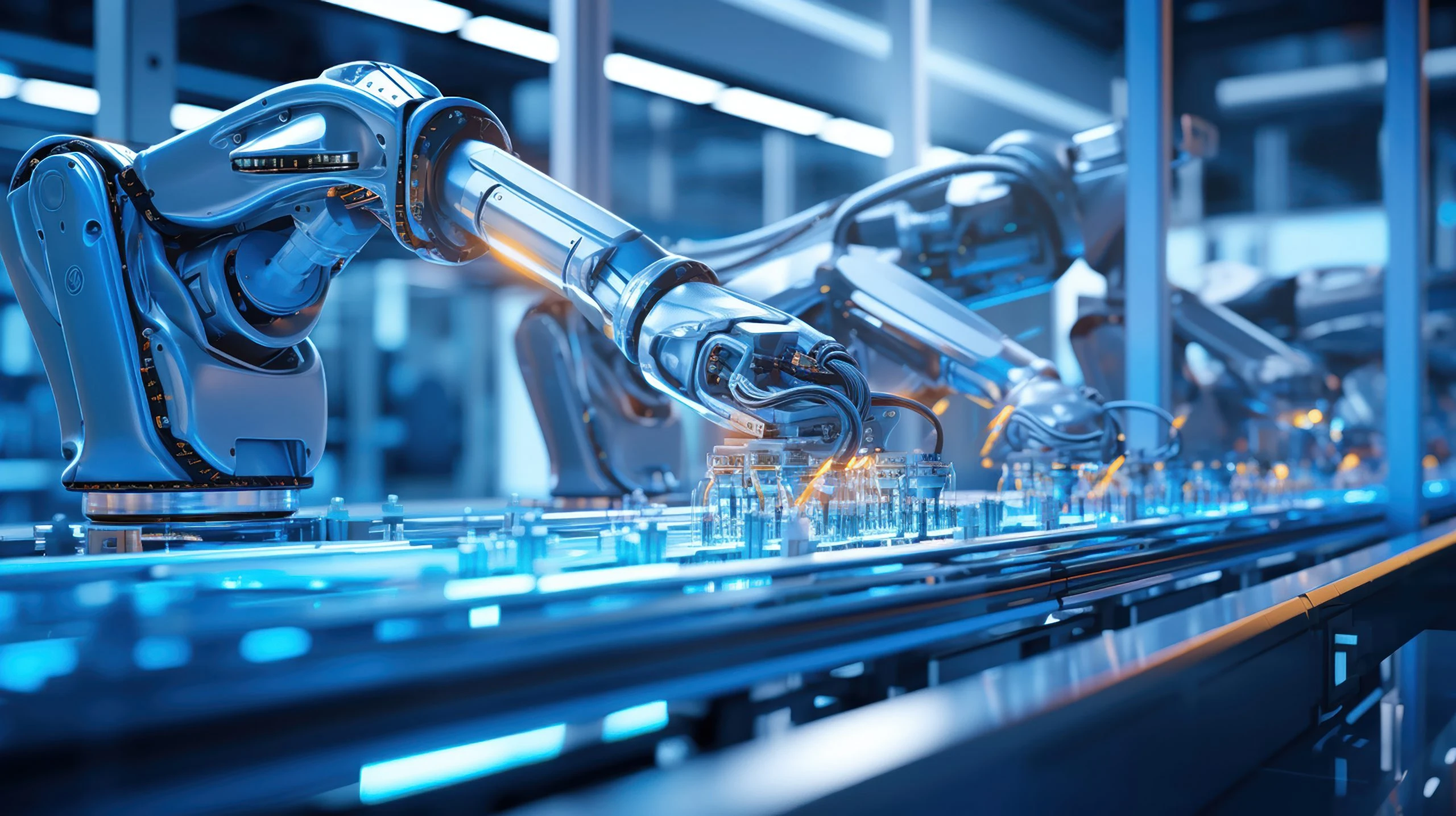
Advanced Machinery
Exploring the World of Modern Industrial Machines
Exploring the World of Modern Industrial Machines
Modern manufacturing relies on sophisticated machines that combine mechanical precision with digital intelligence. Understanding these systems is essential for engineers and technicians working in today's industrial landscape.
Industrial machinery has evolved from simple mechanical devices to complex cyber-physical systems. Today's machines integrate sensors, actuators, controllers, and software to achieve levels of precision and productivity unimaginable just decades ago.
The convergence of mechanical engineering, electronics, and computer science has created a new generation of intelligent machines capable of self-monitoring, adaptation, and optimization.
From CNC milling centers that can hold tolerances measured in microns to laser cutting systems that process materials with focused energy beams, modern machinery represents the cutting edge of manufacturing technology.
Understanding how these machines work, how to program them, and how to maintain them is crucial for anyone pursuing a career in advanced manufacturing.
Understanding different types of industrial machinery and their applications
CNC milling machines use rotating cutting tools to remove material from workpieces. Modern machining centers feature multiple axes of motion, automatic tool changers, and sophisticated control systems.
Three-axis machines move in X, Y, and Z directions, suitable for basic prismatic parts. Five-axis machines add rotational axes, enabling complex geometries and reducing setup time.
Applications include aerospace components, medical implants, automotive parts, and precision tooling. High-speed machining variants can achieve material removal rates exceeding 1000 cubic centimeters per minute.
Laser systems use focused light energy to cut, engrave, weld, and mark materials. CO2 lasers excel at processing non-metals, while fiber lasers offer superior performance on metals.
Power levels range from watts for marking to tens of kilowatts for thick plate cutting. Beam quality, measured by M² factor, determines focusing capability and processing precision.
Modern systems incorporate automatic nozzle changers, intelligent process control, and vision systems for part alignment. Edge quality often rivals or exceeds mechanical cutting methods.
Hybrid machines combine additive manufacturing (3D printing) with subtractive processes (milling). This enables complex near-net-shape building followed by precision finishing in a single setup.
Metal deposition technologies like laser metal deposition or wire arc additive manufacturing build up material layer by layer. Integrated milling operations then achieve final dimensions and surface finish.
Benefits include reduced lead time, minimal material waste, and the ability to repair high-value components. Aerospace and energy sectors are early adopters of this technology.
EDM removes material through controlled electrical sparks between an electrode and workpiece submerged in dielectric fluid. The process excels at machining hardened materials and intricate shapes.
Wire EDM uses a thin brass wire to cut complex profiles with exceptional accuracy. Sinker EDM employs shaped electrodes to create cavities for mold and die applications.
Surface finish can reach Ra values below 0.1 microns. Modern machines feature automatic wire threading, adaptive control, and multiple axis rotary tables for 5-axis capabilities.
Deep dive into machine specifications and operational fundamentals
Spindle speed measured in RPM determines surface finish and tool life. High-speed machining spindles reach 40,000 RPM or more. Power delivery, thermal stability, and bearing design are critical factors.
Linear encoders and ball screws achieve positioning resolution below 1 micron. Thermal compensation algorithms adjust for temperature-induced expansion. Repeatability is typically tighter than absolute accuracy.
Machine frame construction determines vibration resistance and cutting stability. Polymer concrete beds offer excellent damping. Finite element analysis optimizes rib placement and material distribution.
Servo systems provide precise axis movement with closed-loop feedback. Acceleration rates affect productivity—modern machines achieve 2G or higher. Jerk limiting prevents shock loads on mechanical components.
Heat from spindles, motors, and cutting processes causes dimensional changes. Coolant systems, insulation, and environmental control maintain stability. Some machines use active cooling of critical components.
Automatic tool changers store dozens to hundreds of tools. Tool identification via RFID or data matrix codes prevents errors. Tool life monitoring systems predict when replacement is needed based on usage data.
Performance metrics across different manufacturing technologies
| Technology | Typical Accuracy | Material Removal Rate | Surface Finish | Best Applications |
|---|---|---|---|---|
| 3-Axis CNC Mill | ±0.01 mm | 100-500 cm³/min | Ra 0.8-3.2 µm | Prismatic parts, prototyping |
| 5-Axis Machining Center | ±0.005 mm | 200-1000 cm³/min | Ra 0.4-1.6 µm | Complex aerospace components |
| Fiber Laser Cutting | ±0.1 mm | Up to 20 m/min | Ra 5-15 µm | Sheet metal fabrication |
| Wire EDM | ±0.002 mm | 20-80 mm²/min | Ra 0.1-0.4 µm | Hardened tooling, precision dies |
| Hybrid AM/Machining | ±0.02 mm (after machining) | Variable by process | Ra 0.8-6.3 µm | Complex titanium structures |
Note: Values are typical and vary based on specific machine models, materials, and process parameters.
Best practices for reliable operation and operator protection
Daily: Inspect coolant level, check for unusual sounds, clean chip conveyors, verify tool condition.
Weekly: Lubricate way covers, check hydraulic fluid level, inspect air filters, test emergency stops.
Monthly: Calibrate probing systems, inspect belt tension, check for oil leaks, verify ground connections.
Annually: Laser calibration, ball bar testing, replace seals and gaskets, comprehensive electrical inspection.
Personal Protection: Safety glasses, hearing protection, and proper footwear are mandatory. Avoid loose clothing or jewelry near rotating parts.
Machine Guarding: Never operate with interlocks disabled. Ensure guards are in place before starting cycles. Use chip shields during high-speed operations.
Emergency Procedures: Know the location of emergency stops. Understand lockout/tagout procedures for maintenance. Report any safety concerns immediately.
Poor Surface Finish: Check tool sharpness, verify speeds/feeds, ensure proper coolant flow, inspect spindle bearings for play.
Dimensional Errors: Recalibrate probing system, check for thermal drift, verify work offset values, inspect for tool deflection.
Vibration/Chatter: Reduce depth of cut, adjust spindle speed, verify tool holder taper cleanliness, check machine leveling.
Basic Skills: Blueprint reading, measurement techniques, G-code fundamentals, proper tool selection and setup procedures.
Advanced Techniques: CAM programming, fixture design, process optimization, multi-axis programming strategies.
Continuous Learning: Stay updated on new cutting tool technology, attend manufacturer training, participate in industry forums and conferences.